
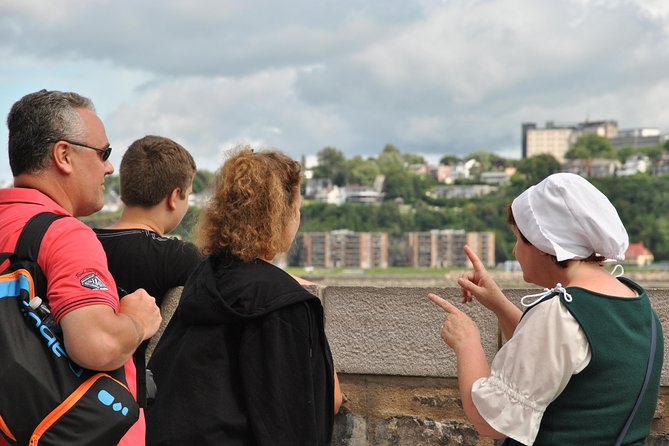
Reviewed · HISTORICAL TOURS
Walking Tour Through Quebec City’s History
Quebec City’s past is easiest to grasp on foot, and this tour gives you a lively route through its most important old quarters. You’ll begin near Dufferin Terrace and Château Frontenac, then work downhill through the walled city toward Place Royale, where Samuel de Champlain founded Quebec in 1608.
I like the small-group format, which allows room for questions, and I like the costumed guides who turn dates and battles into personal stories. Guides such as Keven, Mark, Annabelle, Guy, Louise, Chantal, Gary, and Ives have been praised for making the walk funny, clear, and engaging. The main catch is physical: steep hills, cobblestones, and stairs make this a real walking tour, not a gentle stroll.
Key points at a glance
- A compact route through four centuries: See the upper and lower parts of Old Quebec in about two hours.
- Costumed storytelling: Guides use historical characters and dramatic presentation to make Quebec’s past easier to remember.
- Five major sights: Dufferin Terrace, Notre-Dame de Québec Basilica, Place Royale, Petit-Champlain, and the Breakneck Steps form the core route.
- Small groups matter: The maximum group size is 20, with many departures described as closer to a dozen people.
- Good first-day activity: The route helps you understand the city’s layout before exploring it on your own.
- Prepare for exertion: Wear good walking shoes and expect a long downhill section from the upper terrace to the waterfront.
Why this Old Quebec walk works so well
I like tours that give you a map in your head, not just a list of sights. This one connects the upper town with the lower town, so you see how Quebec City is arranged as you walk. By the time you reach Place Royale, the city’s geography and story begin to fit together.
The route also covers the core of Old Quebec without trying to cram in every corner. You get river views, religious history, military and colonial context, old streets, and one of the city’s most photographed staircases. That makes the tour useful on your first day, when you want to get your bearings quickly.
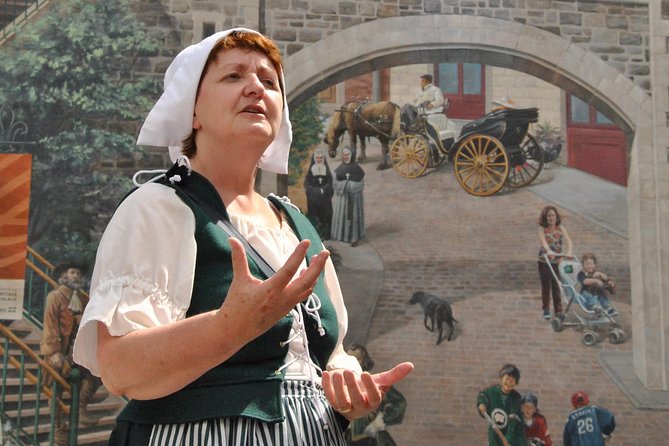
The period costume adds a theatrical touch. Some guides fully adopt the persona of a historical figure, including Gary, whose presentation involved speaking as a person from the past and describing life in striking personal terms. Other guides may be less dramatic and more conversational. Either way, this is not a dry lecture delivered while you stare at a map.
That style will suit you if you enjoy stories and character acting. If you prefer a quiet, strictly academic walk, the performance may occasionally feel like a bit much. One person found the dramatic approach slightly overdone, even while praising the amount of information.
More Historical Tours in Quebec City
- Evening Gourmet Tour 5 Course Dinner – History and Food in Old Quebec City
★ 5.0 · 496 reviews - Quebec City: Old Quebec Historical Walking Tour
★ 4.8 · 409 reviews - Combo Historical and Food Tour of Old Quebec
★ 5.0 · 360 reviews
Starting at Dufferin Terrace beside Château Frontenac
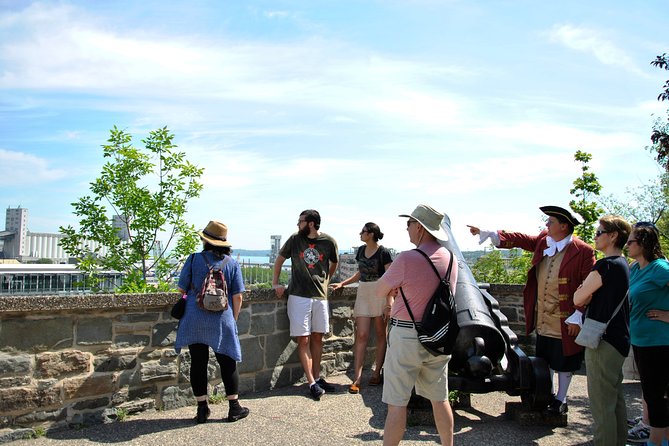
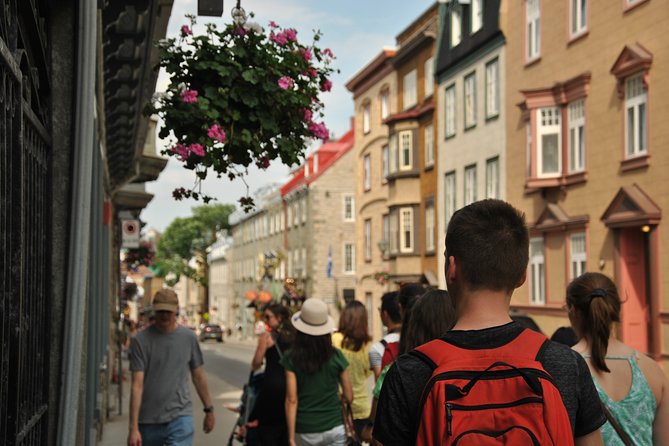
The tour begins at 12 Rue Sainte-Anne, close to the upper town and Dufferin Terrace. The terrace is a long wooden promenade beside Château Frontenac, with open views over the St. Lawrence River and the surrounding area.
This is a smart place to begin. You can look across the river before descending into the older streets, and your guide can explain the city from a broad viewpoint. The terrace also gives you one of Quebec City’s most recognizable scenes right at the start, rather than saving all the visual drama for the end.
The stop here lasts about 10 minutes and has no separate admission charge. That short pause is enough for orientation and photographs without turning the tour into a long stop at one viewpoint.
The walk then moves through the upper part of Old Quebec. Take the downhill route seriously. Several people found the descent tiring, especially older members of the group, and one person described the route as requiring hiking skills. Good shoes are essential on uneven paving, and you should be comfortable walking for close to two hours.
Notre-Dame de Québec Basilica and the city’s religious past
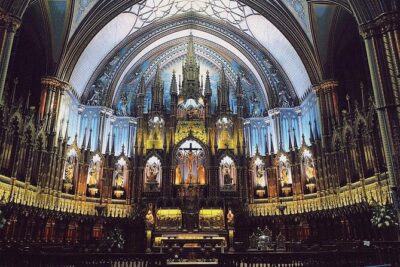
The tour also includes the Basilica of Notre-Dame de Québec, which has occupied the same location since 1647. The cathedral is a Canada National Historic Site because of its architectural importance, and it connects Quebec’s religious life with the city’s political past.
Inside, you may see works of art, archival pieces, elaborate decoration, and a Holy Door. The building also contains the remains of four governors of New France, bishops of the Diocese of Quebec, and a funerary chapel dedicated to François de Laval.
The exact amount of interior time can vary, and the tour is not presented as a dedicated cathedral visit. One useful feature of the route is that the guide provides context before you decide how much more time you want to spend inside later.
That flexibility suits a walking tour. You get the key facts and visual setting, then you can return on your own if the cathedral becomes a priority. The tour focuses on the city as a whole rather than asking you to spend most of the two hours inside one building.
Place Royale, where Quebec City began
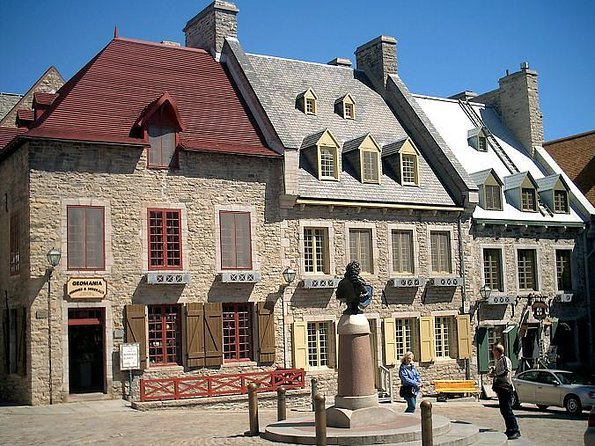
Place Royale is the historical heart of the lower town. Samuel de Champlain founded Quebec here in 1608, and the square still shows the mix of French and British influence that shaped the city.
The buildings around the square give you a clear sense of different periods layered together. The area includes the oldest stone church in North America, adding another strong architectural point to a stop that already carries major historical weight.
The planned stop lasts about 15 minutes. That is enough time for the guide to explain why the square matters, point out its buildings, and answer questions. It is also a good place to pause before the longer walk through Petit-Champlain.
I especially like this part of the route because it links a famous name, Champlain, to a physical place you can stand in. History can feel remote when it is reduced to dates. Here, the founding story is tied to a compact square and the streets around it.
More Walking Tours in Quebec City
- Quebec City Walking Tour
★ 5.0 · 4,716 reviews - Old Quebec City: Grand Walking Tour with Private Option
★ 4.8 · 2,609 reviews - Old Quebec Classique Walking Tour with Funicular
★ 5.0 · 1,317 reviews - Quebec: Crimes of New France Animated Walking Tour
★ 4.6 · 926 reviews
Forty-five minutes in Petit-Champlain

Petit-Champlain receives the longest stop, about 45 minutes, and that makes sense. The district is attractive, tightly packed, and full of lanes that reward slow walking.
You’ll move through streets associated with the founding of Quebec more than 400 years ago. The buildings and narrow lanes create the feeling of a preserved old quarter, but the guide’s role is to add human stories and historical explanation rather than simply point out pretty facades.
This is also where the tour helps you find places you might overlook on your own. One guide led the group through back streets and lanes, while another showed parts of the city that some people had not found independently. The route is not limited to the most obvious postcard view.
Still, allow yourself time after the tour to return to Petit-Champlain at your own pace. The guided stop gives you a useful introduction, but 45 minutes is not enough to linger over every street, shop, or building. Since the tour ends nearby at Place Royale, you can continue exploring without having to cross back to the upper town immediately.
The Breakneck Steps and the downhill reality
The Breakneck Steps, or L’Escalier Casse-Cou, are the oldest outdoor staircase in Quebec City. The steps date from the early French colony and offer a view toward Rue du Petit-Champlain.
The stop itself is short, around five minutes, but it makes a strong point about the city’s shape. Quebec’s upper and lower levels are not simply two names on a map. You feel the change in elevation under your feet.
This is one of the places where the tour’s physical demands become clear. The route includes steep sections, stairs, cobblestones, and descents. Several people advised wearing sturdy walking shoes, and one person specifically wished they had known in advance how many hills and stairs were involved.
I would not book this as a casual stroll if you have trouble with slopes or prolonged walking. The stated fitness requirement is moderate, and that is a fair description. Service animals are allowed, but the physical route still deserves careful thought.
What the cost includes, and where the value lies
At $24.03 per person, the tour is priced as an affordable introduction to Old Quebec. The fee includes a local guide and a professional guide, with no separate admission charge listed for the stops.
The value comes from the route and the interpretation. You could walk along Dufferin Terrace, Place Royale, Petit-Champlain, and the Breakneck Steps by yourself, but you would have to research the connections between them. The guide supplies the timeline, explains the buildings, and answers questions as the city unfolds.
The small-group limit of 20 helps justify the price. A group of roughly 12 can feel much more personal than a large crowd, especially when the guide is answering questions about rulers, architecture, and Quebec’s development.
The strongest guides combine facts with humor. Keven was praised for giving a broad overview while also explaining the people and events behind it. Mark, Guy, Chantal, Louise, Annabelle, Gary, and Ives were each described as entertaining, personable, or strong storytellers. The exact style will depend on who leads your departure, but the tour clearly depends on the guide’s energy.
There are a few practical limitations. Street cleaning and garbage collection can make parts of the commentary hard to hear. Accents may also require extra concentration for some people. If you have hearing concerns, staying close to the guide is sensible.
Why the guide makes the difference
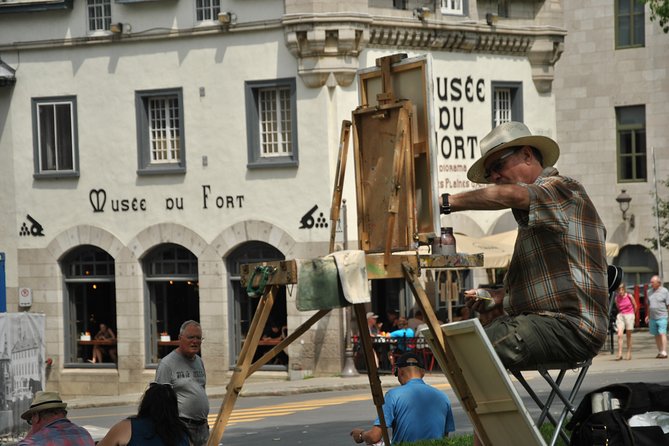
The tour’s central idea is history brought to life through a character. A guide may speak as someone from another era, use personal details, or tell the city’s story as a connected narrative rather than a sequence of facts.
That approach works best when you want to remember what you learned. It is easier to recall a dramatic story about life in the colony than a list of dates. The guide’s humor also keeps the two-hour format from feeling like a classroom lecture.
The style is not uniform. Some guides lean hard into performance, while others focus on clear explanation and questions. Reviews of Keven, Mark, Annabelle, Guy, Louise, Chantal, Gary, and Ives show a broad range of guide personalities, but the common thread is strong command of Quebec’s past and a willingness to engage with the group.
I would recommend this especially to families with older children and teenagers who can listen for two hours. One person suggested age 12 and up because of the amount of spoken information. Younger children may enjoy the costumes and setting, but the length and hills could test their patience.
Timing, group size, and simple planning tips
The walk lasts approximately two hours. It is offered in English and includes a mobile ticket, making it easy to carry the booking on your phone.
The meeting point is 12 Rue Sainte-Anne in Quebec City. The tour ends at Place Royale, described as the birthplace of Quebec, so you finish in a useful area for further independent exploring.
Because the start and finish are in different parts of Old Quebec, plan around the one-way flow. Do not assume you will return to your starting point immediately after the tour. The ending is an advantage if you want to continue through the lower town, but it matters if you have another appointment near the upper terrace.
The tour is available near public transportation, and confirmation is provided when you book. It requires good weather and a minimum number of participants. If bad weather or insufficient bookings cancel the experience, you can choose another date or receive a full refund.
You can cancel for a full refund up to 24 hours before the start time. Changes or cancellations made less than 24 hours before the start are not accepted for a refund.
Who should book this Quebec City tour
I would choose this tour if you are visiting Quebec City for the first time and want the basic layout explained in one efficient walk. It is also a good fit if you enjoy architecture, colonial history, religious sites, and stories told with some humor.
It works especially well on your first day. Afterward, you will know how the upper terrace, cathedral area, lower town, Place Royale, and Petit-Champlain fit together. You can then return to the places that caught your attention.
I would think twice if stairs are difficult for you, if you dislike downhill walking, or if you want a tour with extensive interior visits. Most of the experience takes place outdoors, and the route can be tiring. Noise from city services may occasionally affect the commentary, and a highly dramatic guide may not suit every personality.
Should you book it?
Book it if you want an affordable, story-driven introduction to Old Quebec with a clear route and a small group. The combination of Dufferin Terrace views, the Basilica, Place Royale, Petit-Champlain, and the Breakneck Steps gives you a strong first look at the city.
Skip it if you need a flat route, a slow pace, or a quiet academic presentation. For everyone else, this is a practical way to understand Quebec City before exploring its streets on your own.
FAQ
How long does the walking tour last?
The tour lasts approximately two hours.
How much does the tour cost?
The listed price is $24.03 per person.
What language is the tour offered in?
The tour is offered in English.
Where does the tour start?
The meeting point is 12 Rue Sainte-Anne, Québec, QC G1R 3X3, Canada.
Where does the tour end?
The tour ends at Place Royale in Quebec City.
What sights are included?
The route includes Dufferin Terrace, Notre-Dame de Québec Basilica, Place Royale, Petit-Champlain, and the Breakneck Steps.
How large is the group?
The tour has a maximum of 20 participants.
Is the tour physically demanding?
You should have a moderate fitness level. The route includes hills, stairs, cobblestones, and a substantial downhill section.
Can I cancel for a refund?
Yes. You can cancel at least 24 hours before the start time for a full refund. If poor weather or an insufficient number of participants cancels the tour, you will be offered another date or a full refund.
Just added around Quebec City
- From Montreal: Quebec City & Montmorency Falls Full Day Trip★ 4.5 · 145 reviews
- Stoneham: Nordic spa Thermal Experience★ 4.9 · 20 reviews
- Quebec : Old Town Walking Tour With A Local Guide★ 4.5 · 38 reviews
- Quebec City’s History in Virtual Reality★ 4.5 · 141 reviews
- Quebec Interactive Street Theatre: “Crimes in New France”★ 4.6 · 175 reviews
- Quebec City: Winter Walking Tour in Old Quebec★ 4.9 · 30 reviews
- Québec: Fortifications-of-Québec Guided Walking Tour★ 4.7 · 60 reviews
- Quebec: Christmas Interactive Walking Tour of New France★ 4.3 · 7 reviews
Historical Tours, compared.



Vancouver: Gastown Historical Walking Food Tour
The full write-up →
Evening Gourmet Tour 5 Course Dinner – History and Food in Old Quebec City
The full write-up →
Quebec City: Old Quebec Historical Walking Tour
The full write-up →

Combo Historical and Food Tour of Old Quebec
The full write-up →Browse the lists this tour appears in