

Reviewed · HISTORICAL TOURS
Half-Day Historical Tour of Halifax
Halifax’s past is unusually concentrated: Titanic graves, the 1917 Halifax Explosion, military forts, immigrant stories, and old waterfront buildings all fit into one sprawling six-hour outing. Paul, the guide, connects those pieces while driving you through Halifax, across the harbour to Dartmouth, and out to Fisherman’s Cove.
I especially like the small maximum of 10 people, which makes hotel or port pickup much easier than joining a large coach. I also like the multimedia approach: Paul uses a screen in the van with photos and short videos to add faces and detail to the places outside the windows.
The tradeoff is clear: this is primarily a driving tour with short walks, not a leisurely day spent inside museums or at each landmark. A short cruise-ship port call can make the schedule tight, so confirm your return time before booking.
Key points at a glance

- Paul’s history-led presentation: Expect detailed commentary on Halifax’s military past, Titanic connections, the Halifax Explosion, immigration, architecture, and local figures.
- A real six-hour sweep: The route covers central Halifax, Dartmouth, cemeteries, parks, memorials, and Fisherman’s Cove rather than just the downtown waterfront.
- The noon gun is a major highlight: The tour aims to place you at Halifax Citadel for the firing of the noon gun and the 78th Highlanders’ guard ceremony.
- Titanic and Explosion sites: Fairview Lawn Cemetery, Mount Olivet Cemetery, the Mont Blanc anchor, and the Explosion Memorial offer a sobering look at Halifax’s role in two major disasters.
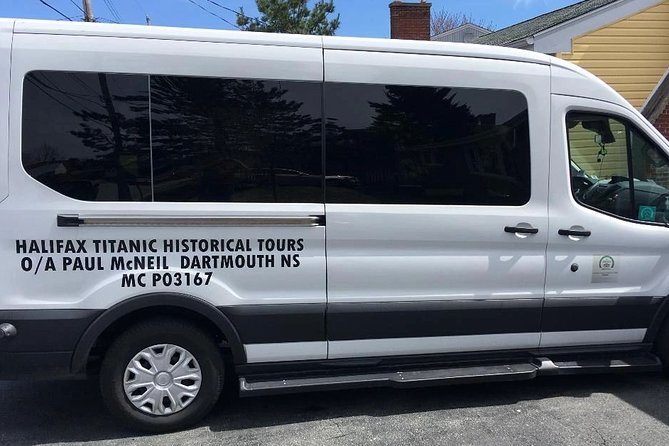
- Comfortable small-group transport: The air-conditioned Ford Transit van carries four to ten people and includes bottled water and onboard WiFi.
- Lunch is optional and extra: Evan’s Seafood in Dartmouth provides a 30-minute stop, but food, drinks, alcohol, and gratuity are not included.
Halifax’s story, told from a high-roof van
This is an ambitious route. In six hours, you move from the waterfront to the Citadel, from Victorian gardens to military cemeteries, and from downtown Halifax across the harbour to Dartmouth and Fisherman’s Cove.
That range is the main reason to choose it. You get a useful sense of how Halifax fits together: a naval city, an immigrant gateway, a provincial capital, and a community shaped by sudden disasters. Paul’s presentation also adds photographs and short video clips on a mounted tablet, which helps when a site is visible only briefly from the road.
The van format matters. You can cover distances that would be tiring on foot, especially between the waterfront, Point Pleasant Park, the cemeteries, and Dartmouth. You will still get out several times, but most stops are short. If you want long museum visits, extended photography sessions, or a slow lunch, this may feel rushed.
The tour is offered in English and requires at least four participants, with a maximum of 10. That is a good size for questions and quick pickup stops. Seating is assigned by booking order, so early confirmation may give you more choice inside the van.
More Historical Tours in Halifax:
- Peggy’s Cove & Halifax Historic Tour
★ 4.5 · 375 reviews - Historic Halifax by Foot
★ 4.5 · 191 reviews - Peggy’s Cove/Mahone Bay & Lunenburg UNESCO HERITAGE SITE.
★ 4.5 · 139 reviews
Pier 21 and the waterfront’s first chapters
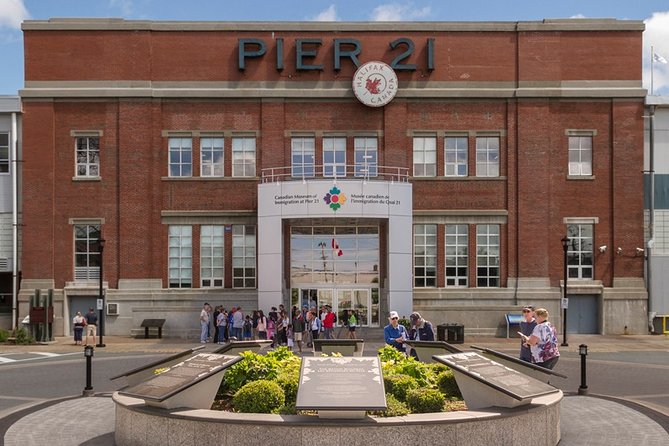
The tour begins near Pier 22 at 1041 Marginal Road, with pickup available from listed downtown hotels and the cruise port. Pier 21 is an apt starting point. It was a major gateway for newcomers to Canada, and Paul explains its place in the country’s immigration story.
Nearby, the Halifax Seaport Farmers’ Market brings the city’s long trading tradition into the present. The market began in 1750, just after Halifax was founded, and operated in several locations before moving to the seaport in 2010. It now houses more than 250 vendors and is described as the longest continuously operating market in North America.
You also hear about the immigrant sculpture by Armando Barbon, who came to Canada from Italy in 1951. Its inscription and family imagery give the broad subject of immigration a personal face. This is one of the more thoughtful early stops because it links Halifax’s old role as a port with the individual families who arrived here.
The waterfront section continues past Sir Samuel Cunard, the Halifax-born founder of the Cunard Line. From there, the route reaches the boardwalk beside Halifax Harbour, one of the defining views of the city. The harbour is not just pretty scenery. Its depth and location explain why Halifax became a major naval base and why military history runs through nearly every part of the tour.
Forts, ships, and the city’s military edge
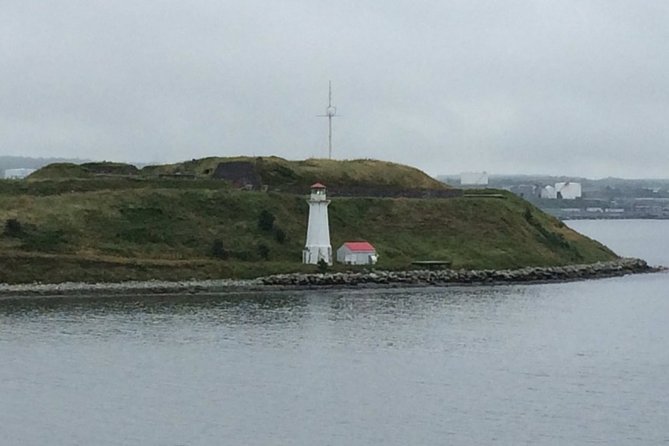
From the waterfront, Paul points out Georges Island in the harbour. The island was part of Halifax’s seaward defence system and later held Acadians during the deportation period between 1755 and 1763. Fort Charlotte, batteries, tunnels, and a lighthouse all add layers to its story.
You do not visit the island on this tour, so think of it as a narrated harbour view rather than an island excursion. That is typical of the day: you see many places and hear their stories, but only a handful receive extended time on foot.
The route also passes Alexander Keith’s brewery, which began almost two centuries ago. The tour focuses on Keith himself and the brewery’s place in Nova Scotia’s working culture. A brewery visit is not part of the package, so do not expect a tasting or a tour inside.
HMCS Sackville offers another naval connection. It is the only surviving example of the 269 Allied corvettes used during the Second World War and serves as Canada’s Naval Memorial. If you have extra time before or after this experience, the Maritime Museum of the Atlantic is a strong companion visit. Its exhibits cover sailing ships, steam, wartime convoys, the Titanic, and the Halifax Explosion, but museum admission and time are not built into this outing.
Old Halifax, from churches to Province House
The central city portion moves quickly but covers a remarkable number of buildings. Historic Properties preserves waterfront warehouses dating from the late 1700s and early 1800s, including Victorian Italianate façades. The area helps you picture Halifax as a trading town rather than only a modern provincial capital.
You hear about Saint George’s Round Church, built in 1800 for a growing congregation. Its unusual circular form reflects the architectural taste of Edward, Duke of Kent. St. Paul’s Anglican Church, founded in 1749, was the first Anglican cathedral outside England and is Halifax’s oldest building. The church contains reminders of the 1917 explosion, including the so-called Ghost Window and a piece of wood embedded in an interior wall.
Other downtown landmarks include Halifax City Hall, Province House, Government House, Saint Mary’s Cathedral Basilica, the Halifax Court House, and All Saints Cathedral. Each adds a different note: municipal government, provincial politics, Georgian residence design, Gothic Revival architecture, law, and Anglican life.
Province House opened in 1819 and is Canada’s oldest legislative building. Government House is the oldest official residence in Canada and remains the home of Nova Scotia’s lieutenant governor. These are usually viewed from outside, so this portion works best for people who enjoy architectural context rather than formal interior tours.
You also hear about Nova Scotian folk artist Maud Lewis and see the modern building whose design resembles a stack of books. The contrast is useful. Halifax is not preserved as one frozen historic district. Old churches and warehouses sit beside contemporary architecture and active civic buildings.
A few more Halifax days worth comparing
- Halifax Harbour Hopper Tour
★ 4.5 · 1,296 reviews - Halifax Peggy’s Cove Express
★ 4.0 · 801 reviews - Wine and Lunch Escape
★ 5.0 · 562 reviews - Halifax Small-Group Express Peggy’s Cove Tour
★ 4.5 · 544 reviews
Camp Hill, the Public Gardens, and the Citadel’s noon gun

Camp Hill Cemetery is one of the short walking stops. It replaced the Old Burying Ground in 1844 and contains the graves of soldiers, public figures, and local residents. Notable names include Viola Desmond, Alexander Keith, Joseph Howe, and Titanic survivor Hilda Mary Slayter.
The Halifax Public Gardens provide a welcome change from monuments and cemeteries. You get about 30 minutes to walk among formal beds, fountains, statues, trees, and ornamental plants inside this 17-acre Victorian garden. The wrought-iron fence and gates frame one of downtown Halifax’s calmest spaces.
The schedule is built around Halifax Citadel National Historic Site. At noon, you are meant to see the famous noon gun, a daily tradition dating to 1856, along with the changing of the guard by the 78th Highlanders. The present fort, also known as Fort George, is the fourth fort on Citadel Hill and has the star-shaped defensive design associated with British military engineering.
Only about 15 minutes is listed for this stop, and admission to the Citadel is not included. That is enough to catch the ceremony and understand the fort’s position, but not enough for a full interior visit. If the Citadel is your main interest, plan a separate admission visit on another day.
The Old Town Clock follows naturally. Prince Edward, Duke of Kent, arranged for the clock in 1800 in an effort to improve the punctuality of the local garrison. It is a small detail, but a memorable one, and the clock gives you one of Halifax’s classic photo stops.
Point Pleasant Park and Halifax’s wider reach

Point Pleasant Park takes you to the southern end of the Halifax peninsula. Its 75 hectares include wooded paths, coastal areas, and remains of early fortifications. The park has 39 kilometres of trails, though this tour gives you only a brief look rather than a long walk.
You then pass Dalhousie University and the University of King’s College. Dalhousie dates from 1818, while King’s College was established in 1789 and is the oldest chartered university in Canada. These stops show how Halifax developed as an education centre as well as a naval and political one.
At the Mont Blanc anchor site, you see a 1,140-pound anchor shaft thrown about 2.3 miles by the 1917 Halifax Explosion. It is a powerful physical reminder of the blast’s force. A cannon thrown nearly three miles to Albro Lake in Dartmouth provides another startling link between the disaster and the route ahead.
Titanic graves and the Halifax Explosion

The cemetery section is the emotional centre of the tour. At Mount Olivet Cemetery, you see markers for 19 Roman Catholic Titanic victims and hear stories connected with Margaret Rice and other people buried there. The site also includes connections to the Halifax Explosion, including Vincent Coleman and Anne Welsh, known as Ashpan Annie.
Fairview Lawn Cemetery contains the graves of 121 Titanic victims. Paul discusses J. Dawson, Sidney Leslie Goodwin, and others whose stories became part of the city’s permanent memory. You also hear about the Halifax Explosion victims buried there.
These visits are not rushed photo opportunities. The listed stops allow about 20 minutes at each cemetery, enough to understand what you are seeing and to reflect. The subject matter is heavy, but the tour treats the disasters as human events rather than as sensational curiosities.
The Halifax Explosion Memorial Bell Tower on Fort Needham looks over the area destroyed on December 6, 1917. The blast killed about 1,900 to 2,000 people, injured another 9,000, and left 25,000 homeless. The memorial also honours the people who rebuilt Halifax and Dartmouth after the destruction.
The nearby Hydrostone district shows part of that rebuilding effort. After the explosion, planners promoted non-combustible concrete blocks finished with crushed rock to reduce the risk of fire. The result is a distinctive neighbourhood of durable row buildings that still reflects the city’s response to catastrophe.
Dartmouth, lunch, Lake Banook, and Fisherman’s Cove
The tour crosses to Dartmouth, where the pace changes from formal landmarks to waterfront community life. Evan’s Seafood is a 30-minute lunch stop with views toward Halifax. Food is ordered separately, and orders may be called ahead to speed service. Gluten-free options are noted, but you pay for your own meal.
This stop is convenient rather than a culinary event built into the tour. If you want lunch, it saves you from finding a restaurant during a packed schedule. If you prefer a long meal or have strict dietary needs, ask about the menu before ordering.
Lake Banook follows, with its links to canoeing, kayaking, rowing, and dragon boating. The lake is also associated with a claim to be the birthplace of ice hockey. It is a useful reminder that Dartmouth is not merely Halifax’s opposite shore. It has its own sporting and community identity.
Fisherman’s Cove is the final major stop. This restored 200-year-old fishing village has colourful buildings, small shops, and plenty of photo opportunities. The half-hour visit gives you a taste of the old working waterfront without turning the day into a shopping trip.
Price, comfort, and port-day timing
At $131.43 per person, the value depends on how much ground you need to cover. The price includes air-conditioned transport, bottled water, WiFi, downtown or port pickup, and a guide-led route through both Halifax and Dartmouth. It does not include lunch, alcohol, gratuity, or Citadel admission.
For a first visit, I find the price reasonable because public transport will not easily connect all the cemeteries, parks, memorials, and outlying waterfront stops in one day. A taxi-based version would also become complicated. The tour is less compelling if you mainly want downtown Halifax, since much of the central area can be explored on foot.
Cruise passengers need to be careful. One account describes a ship departure at 3:30 p.m. and a shortened route, with a walk or ferry connection needed to return to the ship. The guide did return the group in time, but a tight port call leaves little room for weather, traffic, or a missed connection. Give Paul your firm all-aboard time at pickup and do not assume every listed stop will fit.
The van is a Ford Transit 350 XLT High Roof 15 Passenger Van, used for groups of four to 10. Most people can participate, and service animals are allowed. The tour includes short walks, steps, and repeated getting in and out, so it is best suited to someone who can manage those movements. One useful strength is that the experience is primarily vehicle-based, which can help if you cannot walk far, but it is not described as a wheelchair-accessible service.
Who should book this Halifax tour?
I would choose this for a first visit, especially if you want Halifax’s difficult stories explained with care. It suits history fans, cruise passengers with a generous port call, families, and anyone who wants to see Titanic and Explosion sites without arranging separate transport.
It is also a good choice if you enjoy a guide who talks often and brings supporting images. Paul’s presentation is detailed, organized, and strongly focused on local events. You should expect less free time and less conversation among the group because much of the ride is built around listening.
I would skip it if your priority is shopping, a long museum visit, a brewery tasting, or quiet independent wandering. I would also avoid booking it for a very short cruise stop unless you have confirmed the exact pickup and return plan.
Should you book it?
Book this tour if you want a broad, serious, and efficient introduction to Halifax, with Dartmouth, cemeteries, memorials, and Fisherman’s Cove added to the usual downtown sights. The strongest reasons are Paul’s detailed storytelling, the small van, the noon gun timing, and access to places that are awkward to combine on your own.
Before paying, check your cruise schedule, ask how the route will be adjusted if your ship leaves early, and remember that lunch and Citadel admission cost extra. If you accept the driving-heavy format, this is a strong way to understand why Halifax is shaped by the sea, military power, immigration, and two devastating disasters.
FAQ
How long does the Halifax historical tour last?
The experience lasts approximately six hours and ends back at the meeting point.
Where does the tour begin?
The meeting point is Pier 22 parking at 1041 Marginal Road in Halifax. Pickup is available from listed downtown hotels and the cruise port.
How many people are in the tour group?
The tour requires a minimum of four participants and accepts a maximum of 10.
Is lunch included?
No. Lunch at Evan’s Seafood is an optional stop, and food, alcohol, and gratuity are not included.
Is admission to the Halifax Citadel included?
No. The tour includes the Citadel stop and aims to reach the noon gun and guard ceremony, but admission is not included.
What happens if I need to cancel?
You receive a full refund if you cancel at least 24 hours before the experience begins. Cancellations or changes made within 24 hours are not refunded. If poor weather or an insufficient number of participants cancels the tour, you are offered another date or experience, or a full refund.
Just added around Halifax
- Mersey River Quickie Adventure – 2 Hours★ 5.0 · 142 reviews
- Southern Lakes Canoe Trip – 4 Day★ 5.0 · 23 reviews
- Winter Wine Escape★ 5.0 · 8 reviews
- Wine Tour Wolfville Wine Tours in Nova Scotia- 6 Hours★ 5.0 · 14 reviews
- JFarwell Private Yacht Wine & Cheese Sunset Sail★ 5.0 · 18 reviews
- Halifax waterfront SOLAR Party Bike food & drink experience!★ 4.0 · 71 reviews
- Wine Enthusiast Tour Lead by a Sommelier★ 4.5 · 6 reviews
- Private Peggy’s Cove Lighthouse Tour from Halifax★ 4.5 · 19 reviews
Historical Tours, compared.



Vancouver: Gastown Historical Walking Food Tour
The full write-up →
Evening Gourmet Tour 5 Course Dinner – History and Food in Old Quebec City
The full write-up →
Quebec City: Old Quebec Historical Walking Tour
The full write-up →

Combo Historical and Food Tour of Old Quebec
The full write-up →Browse the lists this tour appears in