
Reviewed · HISTORICAL TOURS
Pete’s Historic Walking Tour
Saint John’s story is told best in small pieces: a fire-scorched piece of metal in King’s Square, carved heads above an old bank, a mural about Partridge Island, and a ship model tucked inside Market Square. Pete Ferguson links these details into a 2.5-hour walk that moves from Loyalist settlement to today’s waterfront.
I like the local point of view. Pete once owned Pete’s Pub, knows people across town, and adds personal stories to the formal history. I also like the rare photo copies he uses, which help you picture streets, buildings, and events that have changed.
The main drawback is the amount of standing and listening. This is an easy walk, but it is not a brisk city stroll. If you prefer constant movement, the time spent hearing stories at each stop may feel long.
Key points about Pete’s Saint John walk
- Local guide with personal ties: Peter Ferguson brings stories from a lifetime in Saint John and 35 years connected with his former pub.
- A useful historic sweep: The walk covers Saint John from the Loyalist Landing in 1783 through fire, immigration, business, entertainment, and the modern waterfront.
- Many small details: Look for the molten metal from the Great Fire, carved stone heads, old bank buildings, murals, and the Three Sisters Lamp.
- Easy pace with indoor options: The route can use Saint John’s pedways, escalators, and an elevator to avoid some steep hills.
- Good for cruise visitors: The route finishes near the Marco Polo Cruise Terminal and Area 506 Waterfront Container Village.
- A strong value at $33.80: The price includes the guide and a full morning or afternoon of local context, but lunch and other purchases are extra.
Why this tour works best as an introduction to Saint John
Pete’s Historic Walking Tour is less about entering major attractions and more about learning how to read the city. You will stand outside buildings, parks, streets, and waterfront sites while Pete explains what happened there and why it mattered.
That approach suits Saint John. The city’s appeal is often found in details rather than a long list of famous monuments. A former hotel tells you about early twentieth-century travel. A market reveals the city’s working life. A church connects directly to Loyalist settlement. A mural opens the door to immigration and quarantine on Partridge Island.
The tour is offered in English, with morning and afternoon departures. It is capped at 20 people, though smaller groups are possible. The 4.9 rating from 321 reviews and 99 percent recommendation figure suggest that Pete’s warmth, humor, and clear speaking voice are central to the experience.
You should expect a presentation as much as a walk. Pete is praised for projecting his voice so people at the back can hear, and for answering questions. He also uses copies of rare photographs as visual aids. Those are useful when you are looking at a building that has been altered or a street scene that no longer exists.
More Historical Tours in Saint John:
- Admission 1 person – Visit of the Acadian Historic Village
★ 4.5 · 40 reviews - Mi’kmaq Heritage Path Tour
★ 5.0 · 23 reviews - Family visit to the Acadian Historic Village
★ 4.5 · 7 reviews
Water Street and Market Square: starting with Saint John’s turning points
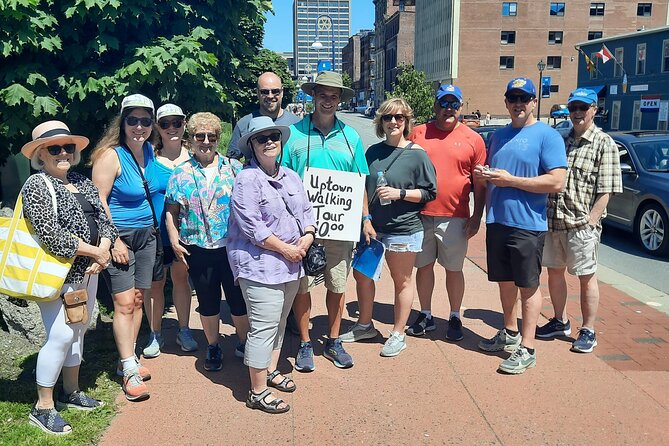
The meeting point is at Duke Street and Water Street. From there, the first stop is near Furlongs liquor store on Water Street, on the way to Market Square. This opening section is brief, but it sets the tone: ordinary streets become clues to the city’s past.
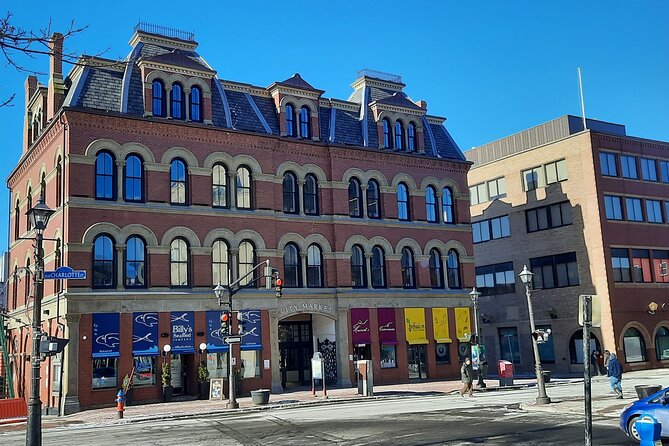
At Market Square, Pete explains the Loyalist Landing of 1783 and the beginning of the Great Fire of Saint John. He also points out where Prince Charles and Lady Diana made a walkabout. These subjects place local history in several different periods, from the city’s founding to royal visits.
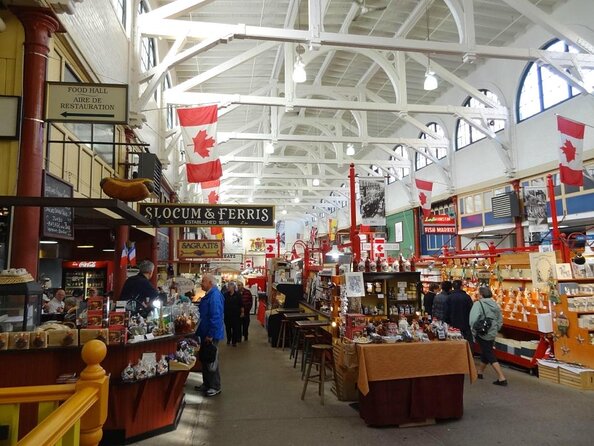
Inside Market Square, you will see the Marco Polo sailing ship model. Pete explains the famous ship’s story, adding a maritime thread before the route turns toward civic buildings and old commercial streets.
The stop is scheduled for about 15 minutes. You should not expect a long shopping break here. There may be a few extra minutes to browse later at the City Market, but the focus is the commentary, not retail time.
City Hall and the story behind Pete’s Pub
At Saint John City Hall, the tour shifts from public history to Pete’s own connection with the city. He explains the history of Pete’s Pub, which he owned, and shares stories about sports, entertainment, and his 35 years at the pub.
This is one of the more personal sections of the walk. It helps explain why the tour feels different from a standard overview delivered from a script. Pete uses his own experiences to show how a city’s social life develops around local businesses and familiar meeting places.
If you enjoy local personalities and conversational storytelling, this stop should work well. If you want only architectural facts, it may feel less essential. That is part of the tradeoff: Pete’s tour gives you Saint John as a lived-in hometown, not just as a collection of dates.
The City Market and Charlotte Street murals

The Saint John City Market is one of the tour’s key stops. Pete explains its architectural features and history, including its place as the oldest continuously operating market in Canada.
The market is a practical place to pause because it gives you a look at the city’s everyday character. The tour allows a few extra minutes for shopping, but do not count on a long independent visit. One useful tip is to check the market’s hours before booking, especially on a Sunday, when hours may be limited.
After leaving the market, the route reaches Charlotte Street. Here Pete points out large murals of famous Saint John people, tucked along an alley. This is the sort of detail you might miss when walking alone, and it gives the route a welcome change of pace after the market’s formal architecture.
More Walking Tours in Saint John:
- Saint John Walking Tour
★ 4.5 · 39 reviews - Saint John Walking Tour
★ 3.9 · 7 reviews - Quebec City Walking Tour
★ 5.0 · 4,716 reviews - Old Quebec City: Grand Walking Tour with Private Option
★ 4.8 · 2,609 reviews
King’s Square: fire, statues, and a bandstand
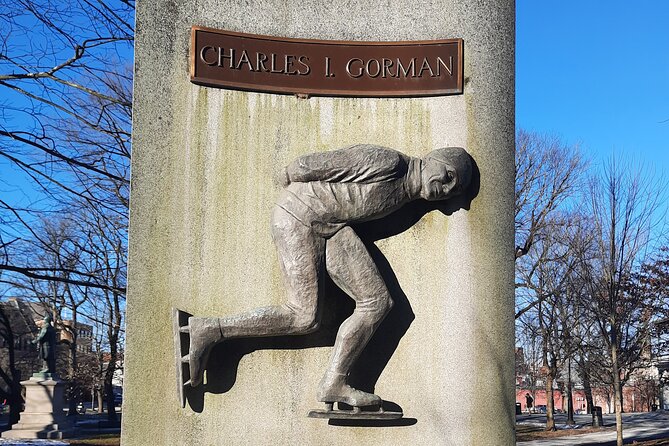
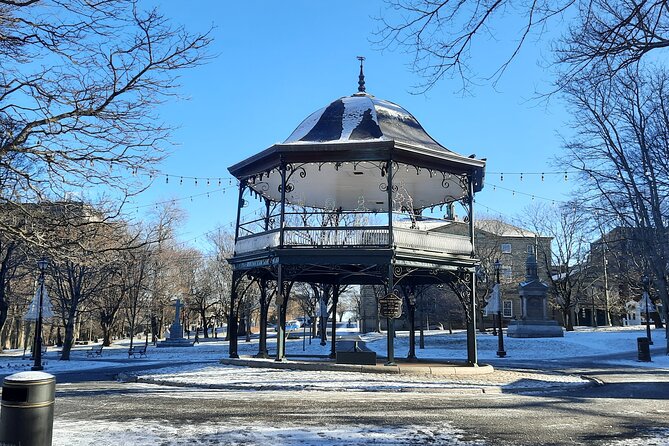
King’s Square was established in 1785, and Pete uses the park to explain several layers of Saint John’s past. You will see a mass of molten metal left by the Great Fire, the William Young statue, the Charles Gorman statue, and the King Edward VII Bandstand.
The molten metal is especially effective because it makes the fire tangible. A date in a guidebook can remain abstract. A twisted piece of material gives you something physical to examine while Pete describes the event and its effect on the city.
The park is also a good listening stop. The tour includes frequent pauses where you can sit or rest while Pete speaks. That helps make the route manageable for many people, though you should still expect to be on your feet for much of the 2.5 hours.
Irving Oil, the Imperial Theatre, and the Admiral Beatty
Across from King’s Square, Pete explains the history of the Irving family and Irving Oil, beginning with K.C. Irving in 1899. This stop adds business history to the walk and shows how one family became important in New Brunswick.
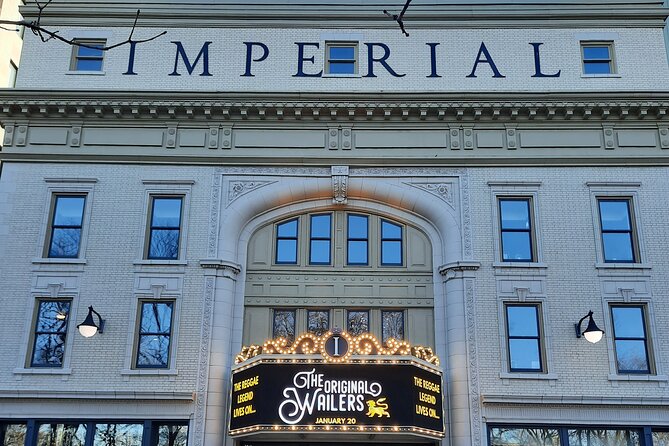
The nearby Imperial Theatre begins another story. Pete describes its start as a vaudeville theatre in 1913, along with its chandeliers and other features. The focus here is not only the building’s appearance, but also its role in Saint John’s entertainment life and restoration.
Next comes the Admiral Beatty building, beside the theatre on King Square South. It began as a luxury hotel in 1925. Pete points out famous visitors, including Amelia Earhart before her transatlantic flight.
These three stops work well together because they cover commerce, theatre, and travel. They also show why Saint John rewards a guide who pays attention to buildings that might otherwise look like ordinary city blocks.
Trinity Church and Germain Street’s Loyalist connections
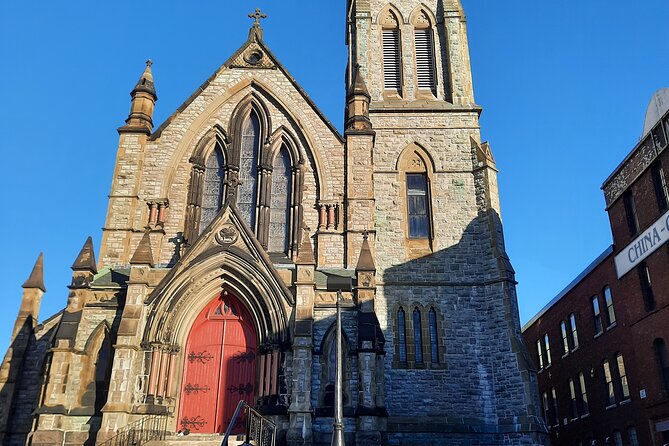
Trinity Church is one of the most important stops on the route. Pete explains the history and features of this Loyalist church, including four main artifacts held inside it.
The church gives the 1783 Loyalist story a physical anchor. Earlier, you heard about the landing at Market Square. Here, you see how Loyalist identity continued through institutions, worship, and architecture.
After leaving Trinity Church, the group walks along Germain Street, named for Lord George Germain. Across from the church is the Union Club, a business club founded in 1884. Pete explains its history and its place in the city’s old commercial society.
This section is best for you if you enjoy connections between people, institutions, and buildings. The route does not simply point out a church and move on. It shows how Saint John’s streets were shaped by the groups that lived and worked there.
Princess Street and the city’s preservation choices
At the corner of Germain and Princess Streets, the route turns toward Prince William Street. Pete points out an example of a newer building designed to conform to preservation standards.
That detail matters because historic districts are not frozen in time. You get a quick lesson in how a city can add modern construction without ignoring the older streetscape. Next to it is the historic Ritchie building, whose features Pete explains.
This is a short stop, but it adds useful context. You will see that preservation is not only about keeping old buildings untouched. It is also about how new buildings fit into an established street.
Prince William Street, once called Canada’s Wall Street
Prince William Street is one of the densest portions of the tour. After walking downhill from Princess Street, Pete points out major buildings and features along a street once known as the Wall Street of Canada.
The stops include Chubb’s Corner, with its carved stone heads; the old City Hall; the old post office; the Jarvis building; the Bank of New Brunswick Palatine building; and the Seamen’s Mission.
This is where the visual aids can be particularly useful. You are looking at a group of historic facades, and Pete’s photographs help show how the street changed over time. The details also give you reasons to look upward and across the street instead of walking past with your eyes at pavement level.
Across from the Seamen’s Mission is a mural depicting Partridge Island. Pete explains the island’s role in immigration and quarantine, with special attention to Irish arrivals during the Potato Famine.
Partridge Island adds a serious note to the tour. It reminds you that Saint John was not only a port for trade and travel. It was also a point of arrival for people facing illness, uncertainty, and difficult conditions. The mural gives you a way to understand that story without visiting the island itself.
The Three Sisters Lamp and the waterfront finish
At the foot of Prince William Street, the route reaches the Three Sisters Lamp in St. Patrick Park. Pete explains the origin of the name and how the lamps helped save lives.
This is a compact but memorable stop. It connects the city’s waterfront to practical navigation and safety, showing how a small object could matter to people approaching the harbor.
The walk ends near the Marco Polo Cruise Terminal and Area 506 Waterfront Container Village. Pete explains how the cruise industry began in Saint John and how the waterfront has developed.
This finish is handy if you are visiting on a cruise because you are already close to the ship area. The information also gives the route a clear arc: Saint John’s past as a port, its working waterfront, and its current role as a cruise destination.
The tour information also says the activity ends back at the meeting point, while the route description places the final stop at the cruise terminal. Confirm the exact end location with Pete before setting out, especially if you have a ship departure, meal reservation, or another timed activity.
Walking level, group size, and timing
The walk lasts about 2 hours and 30 minutes. It is described as easy rather than strenuous, and some groups have used indoor pedways, escalators, and an elevator to avoid the steepest hills.
That does not mean you should treat it as entirely effortless. You will walk between stops and spend time standing while Pete talks. Wear comfortable shoes, and allow extra time if the weather is poor or if you need more frequent breaks.
The tour has a maximum of 20 people. A small group makes it easier to hear and ask questions, while Pete’s strong speaking voice helps people at the back. Morning and afternoon times give you some flexibility.
Service animals are allowed, and pet dogs are welcome. Special-needs children are free. A person using a wheelchair has been accommodated, and the indoor route options may help, but you should contact the provider in advance to discuss your needs and the exact route that day.
The tour requires good weather. If poor weather cancels it, you can receive a full refund or arrange another date. Otherwise, cancellation is free up to 24 hours before the start time. Changes made less than 24 hours ahead are not accepted.
Is $33.80 a fair price?
At $33.80 per person, this is a reasonable price for a 2.5-hour guided introduction to Saint John. You are paying for a local guide, a carefully connected route, visual material, and access to stories that are easy to miss when sightseeing alone.
The value is strongest if you are new to Saint John or have only one day in port. Pete covers the main uptown sights without asking you to pay separate admission at each stop. You can then return to the City Market, Trinity Church, or waterfront with a better sense of what you are seeing.
The value is less clear if you want a fast-paced walk, long shopping time, or extensive interior visits. Most stops are outside, and much of the experience is listening. Lunch is not included, so plan to eat before or after the tour.
Who should book Pete’s Historic Walking Tour?
I would choose this tour if you want local stories, historic buildings, and a guide who is comfortable mixing facts with humor. It suits first-time visitors, cruise passengers, history fans, and anyone who likes to understand a city through its streets rather than race from one major attraction to another.
It also works for people who want an easy pace. You can hear Pete explain the site, ask questions, and take a break before moving on. His local connections and personal stories add character that a self-guided walk cannot easily match.
I would think twice if your priority is shopping, constant movement, or a short overview. The tour can feel long when you are standing at several points, and the market stop does not leave unlimited time to browse.
Should you book it?
Book Pete’s Historic Walking Tour if you want Saint John explained by a hometown guide who combines Loyalist history, fire, immigration, business, theatre, ships, and personal memories. The price is fair, the route covers a useful stretch of uptown, and the indoor walkway option can make the hills easier.
Skip it only if you prefer to explore at your own speed or want more time inside the market and other buildings. For most first visits, I would take the tour early in your stay, use Pete’s stories to get your bearings, then return to the places that catch your interest.
FAQ
How long is Pete’s Historic Walking Tour?
The tour lasts approximately 2 hours and 30 minutes.
How much does the tour cost?
The listed price is $33.80 per person.
Where does the tour begin?
The meeting point is at Duke Street and Water Street in Saint John, New Brunswick.
Where does the tour finish?
The route description finishes at the Marco Polo Cruise Terminal and Area 506 Waterfront Container Village. The booking information also says the activity ends back at the meeting point, so confirm the exact end location with the provider before the tour.
Is the tour offered in English?
Yes. The tour is offered in English.
Are there morning and afternoon departures?
Yes. Morning and afternoon tour times are available.
Can I cancel for a full refund?
Yes, if you cancel at least 24 hours before the experience start time. Cancellations made less than 24 hours ahead are not refunded. If poor weather causes the provider to cancel, you are offered another date or a full refund.
Just added around Saint John
- Hike & Lunch with Llamas★ 5.0 · 26 reviews
- Mi’kmaq Heritage Path Tour★ 5.0 · 23 reviews
- Astounding Scavenger Hunt: Moncton Canada’s Cultural Hub★ 4.0 · 5 reviews
- Family visit to the Acadian Historic Village★ 4.5 · 7 reviews
- Kayak the Bay of Fundy Sea Caves★ 5.0 · 20 reviews
- Kings Landing Admission Ticket★ 4.5 · 28 reviews
- Saint John River: River Relics Kayak Tour★ 5.0 · 7 reviews
- Saint John Walking Tour★ 3.9 · 7 reviews
Historical Tours, compared.



Vancouver: Gastown Historical Walking Food Tour
The full write-up →
Evening Gourmet Tour 5 Course Dinner – History and Food in Old Quebec City
The full write-up →
Quebec City: Old Quebec Historical Walking Tour
The full write-up →

Combo Historical and Food Tour of Old Quebec
The full write-up →Browse the lists this tour appears in